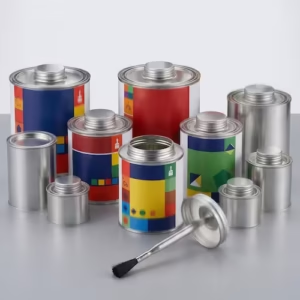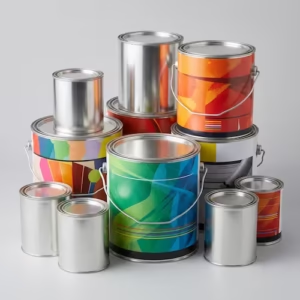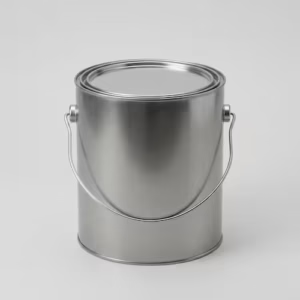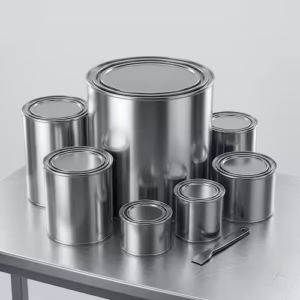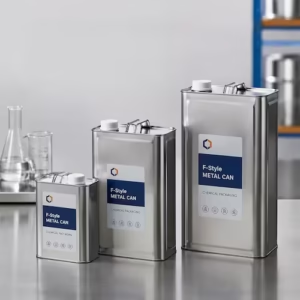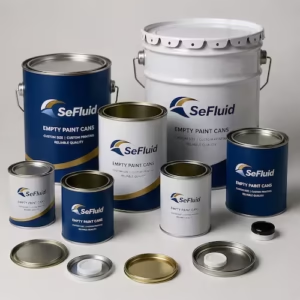












Lattine industriali con tappo a vite: imballaggi progettati per solventi e prodotti chimici.
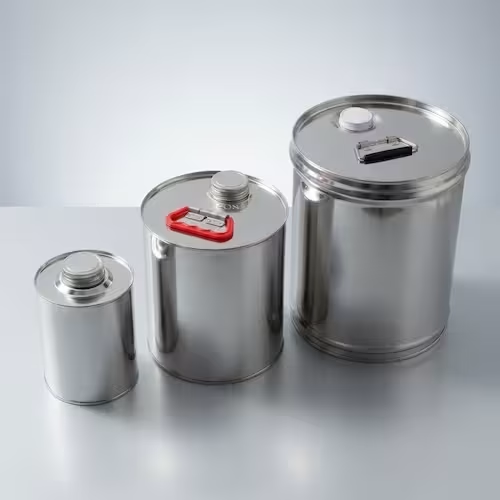
For chemical formulators, adhesive manufacturers, and automotive fluid bottlers, packaging failure is rarely a cosmetic issue—it is a hazardous material liability. When packaging high-solvency liquids, low-viscosity oils, or volatile organic compounds (VOCs), standard friction-closure tins frequently fail under internal vapor pressure or transit vibration.
SeFluid manufactures precision-engineered screw top cans specifically developed to eliminate solvent migration, side-seam weeping, and cap back-off in high-stress industrial supply chains.
Richiedi informazioni
Engineering Principles Behind High-Performance Screw Top Cans
The primary mechanical advantage of a threaded metal closure lies in 360-degree vertical torque distribution. Unlike lever-lid or push-in friction tops, a precision-rolled thread draws the cap downward at a consistent angle, compressing the internal liner uniformly against the can land.
At SeFluid, our container architecture relies on three core structural pillars:
- Prime Electrolytic Tinplate (SPTE): We utilize high-stiffness MR-grade steel substrate with a standard tin plating weight of 2.8 g/m² to 5.6 g/m². This provides an inherent reducing environment that actively retards internal oxidation when filled with petroleum-based distillates.
- Copper-Wire Resistance Welding: The longitudinal body seam is joined via automated electric resistance welding. This achieves a 1.4x overlap crush weld, eliminating the heavy-metal leaching risks of traditional lead-soldered seams while boosting burst-pressure thresholds.
- 7-Layer Compound Double Seaming: Container bases are spun-sealed using an automated double-seamer injected with a high-nitrile water-based sealing compound. This creates an impermeable barrier against low-surface-tension creeping liquids like toluene, hexane, and MEK (Methyl Ethyl Ketone).
Standard Dimensional & Technical Parameters
To accommodate varying industrial dispensing racks and automated filling lines, SeFluid standardizes its core drawn and welded range across four primary volume tiers:
| Capacità nominale | Body Diameter | Overall Height | Substrate Thickness | Standard Neck Thread |
|---|---|---|---|---|
| 250 ml (8 oz) | 65 mm | 100 mm | 0.23 mm | 32 mm DIN |
| 500 ml (16 oz) | 80 mm | 118 mm | 0.23 mm | 42 mm DIN |
| 1000 ml (32 oz) | 112 mm | 135 mm | 0.25 mm | 42 mm / 57 mm |
| 5000 ml (1 Gallon) | 180 mm | 240 mm | 0.28 mm | 57 mm REL |
Closure Systems and Liner Chemistry Compatibility
A metal container body is only 50% of the containment equation; liner degradation accounts for the vast majority of field leakages. SeFluid pairs its drawn threaded necks with three distinct sealing architectures:
- Expanded Polyethylene (EPE): The baseline industry standard. Excellent elastic recovery for mineral oils, brake fluids, and general automotive additives.
- Induction-Heat Seal Pulp/Foil: Designed for automated bottling lines. Once passed under an induction coil, the aluminum laminate fuses to the tinplate lip, providing a tamper-evident, hermetic seal vital for air-freight pressure differentials.
- PTFE (Teflon) Faced Elastomers: Specified strictly for aggressive ketones, chlorinated solvents, and reactive monomers. PTFE offers virtually zero permeation rates across the classic chemical compatibility chart.
Internal Lacquering and Exterior Lithography
Depending on the chemical aggressiveness of the payload, SeFluid applies targeted surface treatments prior to body forming:
- Unlined (Plain Tin): Recommended for oil-based paints, turpentine, and non-water-miscible hydrocarbons where the tin layer acts as a sacrificial anode.
- Epoxy-Phenolic Lining: Cured at 200°C with a dry film weight of 5–8 g/m². Essential for water-borne coatings, wood preservatives, and acidic curing agents to prevent iron pick-up and pinhole corrosion.
- CMYK Metal Offset Printing: Exterior branding is lithographically printed directly onto the flat SPTE sheets prior to rolling. Our finishes undergo ISO 2409 cross-hatch tape testing to ensure factory labels do not dissolve or delaminate when exposed to solvent drips on the filling line.
Domande frequenti (FAQ)
What is the minimum order quantity (MOQ) for SeFluid cans?
For plain, unlined standard utility sizes (250ml to 1L), our standard MOQ is 5,000 units. For bespoke CMYK printed units or custom inner lacquering runs, the MOQ is set at 10,000 units to absorb the cost of automated lithographic plate registration and oven thermal calibration.
Are your screw top cans suitable for UN-rated hazardous transport?
Yes. When combined with our specified closure torque profiles and high-density closures, designated SeFluid models meet UN Group II and Group III packaging performance criteria for liquid densities up to 1.4 g/cm³ and drop heights of 1.2 meters.
How do you prevent thread deformation during ocean transit?
Drawn screw necks are vulnerable to vertical crushing load. We pack all export shipments using high-ECT corrugated master cartons reinforced with internal layer pads, or utilize heavy-duty palletized stretch-wrapping with rigid polymer edge-protectors to transfer stacking weight directly to the can side-walls.
Can SeFluid provide sample units for accelerated compatibility testing?
We strongly encourage it. We advise clients to conduct a 28-day accelerated stability test at 40°C inside their own laboratory. SeFluid supplies pre-production plain or lined sample vessels specifically for customer formulation validation.
Contattaci ora
Ti consigliamo vivamente di cliccare o scansionare il codice QR qui sotto per parlare direttamente con i nostri tecnici commerciali, in modo che possiamo aiutarti a trovare i prodotti più adatti alle tue esigenze applicative. Oppure puoi contattaci Lasciate un messaggio e vi risponderemo al più presto.
prodotti correlati