











SeFluid Decanter Centrifuge for Reliable Industrial Solid-Liquid Separation
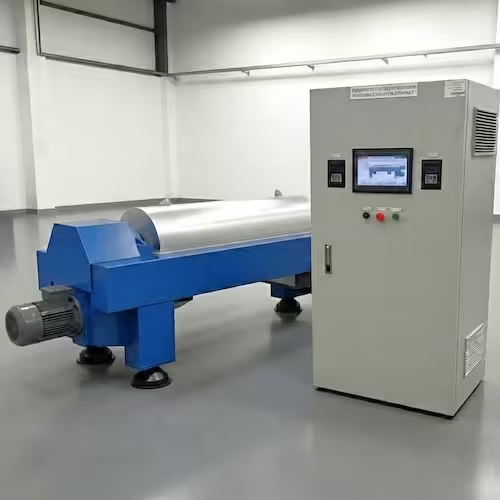
In industries where stable separation performance directly affects production efficiency, operating cost, and discharge compliance, a decanter centrifuge is often one of the most practical solutions. SeFluid designs and manufactures centrifuge systems for continuous solid-liquid separation in wastewater treatment, chemical processing, food processing, mining wastewater, drilling mud treatment, and industrial sludge handling.
Unlike batch filtration equipment, this type of centrifuges operate continuously. Feed slurry enters the rotating bowl, where high centrifugal force separates heavier solids from clarified liquid. The scroll conveyor then transports the settled solids toward the discharge end, while the clarified liquid exits through adjustable overflow ports. This makes the equipment suitable for processes requiring consistent separation efficiency, low moisture cake, and reduced manual intervention.
Richiedi informazioni
Why Choose a SeFluid Decanter Centrifuge?
A SeFluid decanter centrifuge is built for demanding industrial conditions where feed concentration, particle size, viscosity, and flow rate may vary. The system combines a high-speed stainless steel bowl, precision-balanced rotating assembly, wear-resistant scroll conveyor, and variable frequency drive control to provide stable separation results.
Typical applications include municipal sludge dewatering, oily sludge treatment, river dredging slurry, mineral tailings, fermentation broth clarification, starch processing, animal waste treatment, and chemical solid-liquid separation. For customers handling abrasive or corrosive materials, SeFluid can provide wear protection options such as tungsten carbide tiles, hard-facing layers, ceramic liners, and corrosion-resistant stainless steel material.
The result is a horizontal centrifuge that supports continuous operation while improving cake dryness, clarified liquid quality, and overall process reliability.
Key Technical Features
1. High G-Force Separation
SeFluid decanter centrifuges are designed to generate strong centrifugal force for rapid phase separation. Depending on the model and bowl diameter, the machine can typically achieve high G-force performance suitable for fine particle settlement and industrial sludge dewatering.
A higher centrifugal force helps accelerate solid-liquid separation, especially when solids have small particle size or low settling velocity. This is important for wastewater treatment plants, chemical factories, and mining operations where conventional sedimentation tanks may require excessive space and long retention time.
2. Optimized Bowl and Scroll Design
The bowl geometry affects separation zone length, liquid pool depth, residence time, and discharge stability. SeFluid optimizes the bowl structure according to the application, including beach angle, clarification zone, and solids discharge design.
The scroll conveyor runs at a differential speed relative to the bowl. This differential speed controls how quickly solids are conveyed out of the bowl. A lower differential speed may increase cake dryness, while a higher differential speed may improve solids handling capacity. SeFluid can configure the system to balance throughput, cake dryness, and clarified liquid quality.
3. Variable Frequency Drive Control
The centrifuge can be equipped with VFD control for main motor and back drive adjustment. Operators can regulate bowl speed and differential speed to match changing feed conditions.
This is especially useful in industrial sludge and wastewater treatment, where solids concentration may fluctuate during the day. Adjustable speed control helps maintain separation efficiency while reducing unnecessary energy consumption.
4. Durable Materials and Wear Protection
For long service life, the bowl and main wetted parts are commonly manufactured from stainless steel such as SS304 or SS316L, depending on process requirements. In abrasive applications like drilling mud treatment, mineral processing, sand washing wastewater, or ceramic slurry separation, wear protection is essential.
SeFluid offers options including tungsten carbide protection, replaceable wear sleeves, ceramic inserts, and special hard-facing on the scroll conveyor. These features help reduce maintenance frequency and protect critical components from erosion.
5. Continuous Automatic Operation
A SeFluid decanter centrifuge is suitable for continuous feeding, continuous clarification, and continuous solids discharge. Compared with plate and frame filter presses, it usually requires less manual operation and occupies a smaller footprint.
For plants that run multiple shifts or require automated sludge dewatering, the centrifuge can be integrated with feed pumps, polymer dosing systems, control panels, screw conveyors, and sludge storage systems.
Typical Technical Parameters
Actual specifications depend on the model, feed characteristics, and required separation target. SeFluid can customize machine selection based on process data.
Common reference parameters include:
| Parameter | Typical Range |
|---|---|
| Bowl diameter | 200–760 mm |
| Bowl length-to-diameter ratio | 3:1 to 4.5:1 |
| Processing capacity | 0.5–120 m³/h |
| Bowl material | SS304 / SS316L / duplex stainless steel |
| Bowl speed | Approx. 1,500–5,000 rpm |
| Separation force | Up to several thousand G |
| Differential speed | Adjustable by application |
| Control mode | VFD / PLC optional |
| Discharge type | Continuous solids and liquid discharge |
| Wear protection | Tungsten carbide, ceramic, hard-facing optional |
These technical parameters help buyers compare separation performance, but correct selection should also consider feed solids content, particle size distribution, temperature, pH value, viscosity, target cake moisture, and required clarified liquid quality.
Applicazioni
Wastewater and Sludge Dewatering
In municipal and industrial wastewater treatment, sludge volume reduction is a major cost factor. A SeFluid centrifuge can reduce sludge moisture and produce a more transportable cake. When combined with polymer dosing, the system can improve floc formation and enhance cake dryness.
Drilling Mud and Oily Sludge Treatment
For oilfield and drilling applications, the centrifuge separates fine solids from drilling fluid, supports mud recycling, and helps reduce waste disposal volume. Wear-resistant components are recommended because drilling mud often contains abrasive sand and mineral particles.
Chemical and Food Processing
In chemical processing, a centrifuge can separate crystals, catalysts, pigments, polymers, and other suspended solids. In food processing, it may be used for starch slurry, protein recovery, fermentation broth, fruit and vegetable processing streams, and edible oil-related clarification, depending on material compatibility and hygiene requirements.
Mining and Mineral Wastewater
Mining wastewater, tailings slurry, coal washing water, and mineral processing streams often require high-capacity solid-liquid separation. SeFluid centrifuge systems can help recover process water, reduce sedimentation load, and improve overall plant water management.
How SeFluid Supports Better Separation Performance
SeFluid does not treat the centrifuge as a one-size-fits-all machine. The company evaluates process conditions before recommending a configuration. Important selection data may include slurry density, solids percentage, particle size, pH, temperature, abrasiveness, viscosity, hourly flow rate, required cake dryness, and discharge standards.
Based on these details, SeFluid can help determine bowl diameter, rotating speed, beach angle, scroll structure, wear protection level, motor power, control method, and auxiliary equipment. This engineering-based selection process helps customers avoid undersized equipment, unstable operation, excessive energy use, and poor separation results.
Domande frequenti (FAQ)
What is a decanter centrifuge used for?
This type of centrifuge is used for continuous solid-liquid separation. It is commonly applied in sludge dewatering, wastewater treatment, drilling mud cleaning, chemical processing, food processing, mining wastewater, and industrial slurry clarification.
How does the centrifuge work?
The feed slurry enters a high-speed rotating bowl. Centrifugal force pushes heavier solids to the bowl wall, while lighter liquid forms an inner layer. The scroll conveyor moves solids toward the discharge outlet, and clarified liquid exits through overflow ports.
What factors affect separation efficiency?
Key factors include bowl speed, differential speed, feed flow rate, solids concentration, particle size, liquid viscosity, polymer dosing, pool depth, residence time, and wear condition of the scroll conveyor and bowl.
Can SeFluid customize the centrifuge?
Yes. SeFluid can customize bowl material, wear protection, control system, motor configuration, sealing type, discharge method, and auxiliary equipment according to the customer’s process requirements.
Is a decanter centrifuge better than a filter press?
It depends on the application. This type of centrifuge is better for continuous operation, compact installation, and automated sludge dewatering. A filter press may achieve lower cake moisture in some cases but usually requires batch operation and more manual handling.
What information is needed for model selection?
For accurate selection, it is best to provide feed capacity, solids content, particle size, slurry density, viscosity, pH, temperature, target cake moisture, required liquid clarity, operating hours, and whether the material is abrasive or corrosive.
prodotti correlati