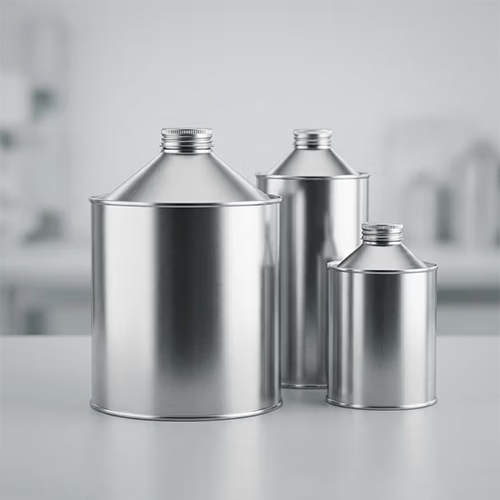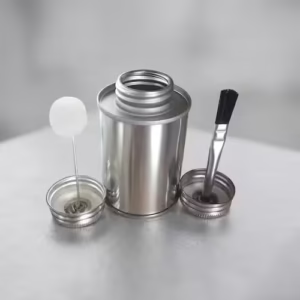












Engineering Superior Protection: Premium Lever Lid Tin Cans for Industrial Packaging
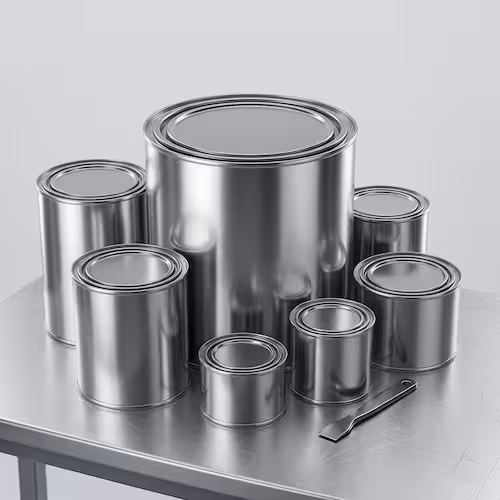
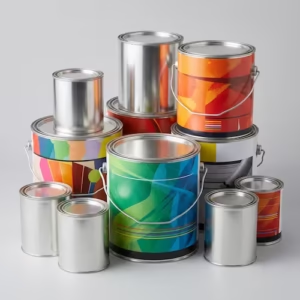
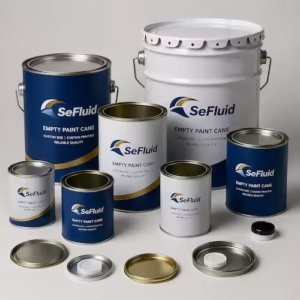
Industrial manufacturers require reliable containment solutions that secure high-value chemical formulations against moisture entry, volatile organic compound (VOC) leakage, and atmospheric exposure. SeFluid delivers high-performance lever lid tin cans engineered from precision-rolled tinplate steel to provide uncompromising structural integrity and airtight sealing dynamics for paints, solvents, adhesives, and coatings.
Our commercial-grade industrial metal packaging line integrates specialized closure mechanics designed to withstand the harsh realities of global logistics while maintaining product purity from the filling line directly to the end-user.
Informationen anfordern
Technical Specifications & Structural Engineering of Lever Lid tin Cans
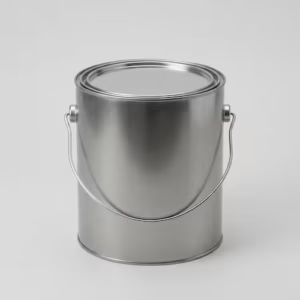
SeFluid designs tinplate steel containers utilizing precise mechanical tolerances. Every cylindrical container features a reinforced triple-tite or double-tite friction ring system. When the lever lid is pressed into place, it creates multiple continuous contact points along the rim, forming a high-performance mechanical seal that prevents the evaporation of highly volatile solvents.
| Parameters & Attributes | Technical Standards & Specifications |
|---|---|
| Material Composition | Electrolytic Tinplate (ETP) according to EN 10202 |
| Capacity Volume Range | 250ml, 500ml, 1 Liter, 4 Liters (1 Gallon), 5 Liters |
| Internal Coatings | Plain Unlined (for solvent-based) / Epoxy-Phenolic Lacquered (for water-based) |
| External Decoration | Plain Metallic / Custom Lithographic CMYK Printing |
| Bottom Closure Style | Double-seamed with advanced synthetic sealing compounds |
| Material Thickness | 0.21mm – 0.28mm nominal wall thickness (dependent on volume capacity) |
Our unlined tin pails are ideal for completely dry environments or pure solvent chemical packaging solutions, such as toluene, acetone, and thinners, where chemical reactivity with internal lacquer barriers must be avoided. For water-borne paints and emulsions, SeFluid applies an advanced, cross-linked epoxy-phenolic lining to prevent oxidation and interior rust formation.
Optimizing Storage Integrity via the Friction Top Mechanism
The core performance of a triple-tite paint can relies on the tight interface between the multi-grooved ring and the matching lid lever. SeFluid utilizes specialized stamping matrices that ensure consistent radius uniformity across every production batch.
Unlike standard plastic containers, these air-tight friction top pails offer complete oxygen impermeability and superior UV protection. This entirely eliminates structural degradation caused by UV exposure during extended warehousing or container shipping. Furthermore, the robust top-and-bottom chime configuration maximizes vertical stacking strength, allowing warehouse facilities to optimize overhead floor space without risking lower pallet collapse.
Industrial Applications & Chemical Compatibility
SeFluid engineering focuses heavily on versatile cross-industry performance. Our lever lid containment configurations are extensively used across the following critical sectors:
-
Automotive Refinishing: Securing highly volatile clear coats, hardeners, primers, and poly-urethane body fillers.
-
Industrial Coatings: Transporting heavy-duty marine anti-fouling paints and architectural protective enamels.
-
Klebstoffe und Dichtstoffe: Preventing premature air-curing of commercial polyurethane glues, contact cements, and resin bases.
-
Wood Treatment Chemicals: Safely storing timber stains, wood preservatives, varnishes, and penetrating oils.
Häufig gestellte Fragen (FAQ)
What is the difference between single, double, and triple-tite lever lid tin cans?
The naming indicates the number of continuous interlocking sealing faces between the lid and the container ring. A standard single-tite lid features one point of contact. SeFluid triple-tite configurations feature three distinct interlocking surfaces. This creates a tortuous pathway that significantly drops the risk of product leakage under external pressure shocks during shipping and ensures superior airtight protection.
Can lever lid tin cans be recycled at the end of their lifecycle?
Yes, tinplate steel is 100% recyclable and retains its intrinsic mechanical properties infinitely. Because it possesses magnetic characteristics, industrial metal packaging can easily be separated from waste streams using magnetic separators, making it one of the most sustainable heavy-duty packaging mediums available globally.
How do I select the right internal lining for my chemical product?
Selecting the right coating is dependent on your product formulation’s water content. Solvent-based products (such as traditional oil paints or chemical thinners) do not react with raw metal and are best suited for plain, unlined tin cans. Water-based formulas contain moisture that induces corrosion on raw steel; these require an internal epoxy-phenolic or organosol resin lacquer shield to maintain chemical stability.
What tools are required to close and reopen these friction top containers?
On automated production lines, standard pneumatic press plates or roller capping machinery seal the friction lids securely into the rings. For manual processing or final field usage, the lid can be pressed firmly into place using a non-marring rubber mallet. Reopening is cleanly achieved by inserting a standard flat-head lever tool or paint can opener beneath the lip edge and lifting upward sequentially around the circumference.
Sprechen Sie jetzt mit uns
We strongly recommend that you either click or scan the QR code below to talk directly with our sales engineers so that we can help you find the most suitable products for your application needs. Or you can contact us by leaving your message and we will answer you soon.
Verwandte Produkte